
Good landscape lighting should make routes, changes in level, entries, and gathering areas easier to read after dark without turning the yard into a floodlit stage. The most useful plan starts with what people need to see, then adds restrained accent lighting for depth and atmosphere.
TL;DR: Light the path of travel first, keep glare out of people's eyes, use several modest light sources instead of one overpowering fixture, and put lights on controls so they run only when useful. Treat style choices as preferences, but treat electrical installation, wet-location equipment, and local code requirements as safety matters.
Start With Nighttime Tasks Rather Than Fixture Shopping
Walk through the yard after sunset and note where someone naturally slows down, changes direction, steps up or down, reaches for a gate, handles keys, cooks, or moves from a bright interior into a darker outdoor space. Those moments create the lighting plan. A decorative fixture can be attractive, but its value depends on whether its beam lands where a person actually needs visual information.
A useful lighting plan can combine route, task, and accent layers. Route lighting supports movement, task lighting helps with activities such as opening a door or preparing food, and accent lighting adds depth to walls and planting. The layers can overlap, but each fixture should have a clear job.
The U.S. Department of Energy's guidance on exterior lighting emphasizes efficient luminaires and controls, while its discussion of light at night highlights the need to balance visibility with unwanted environmental effects. For a residential yard, that supports a simple principle: use enough light for the task, direct it carefully, and avoid sending light where it is not needed.
Build a Safer Route From the Door Outward
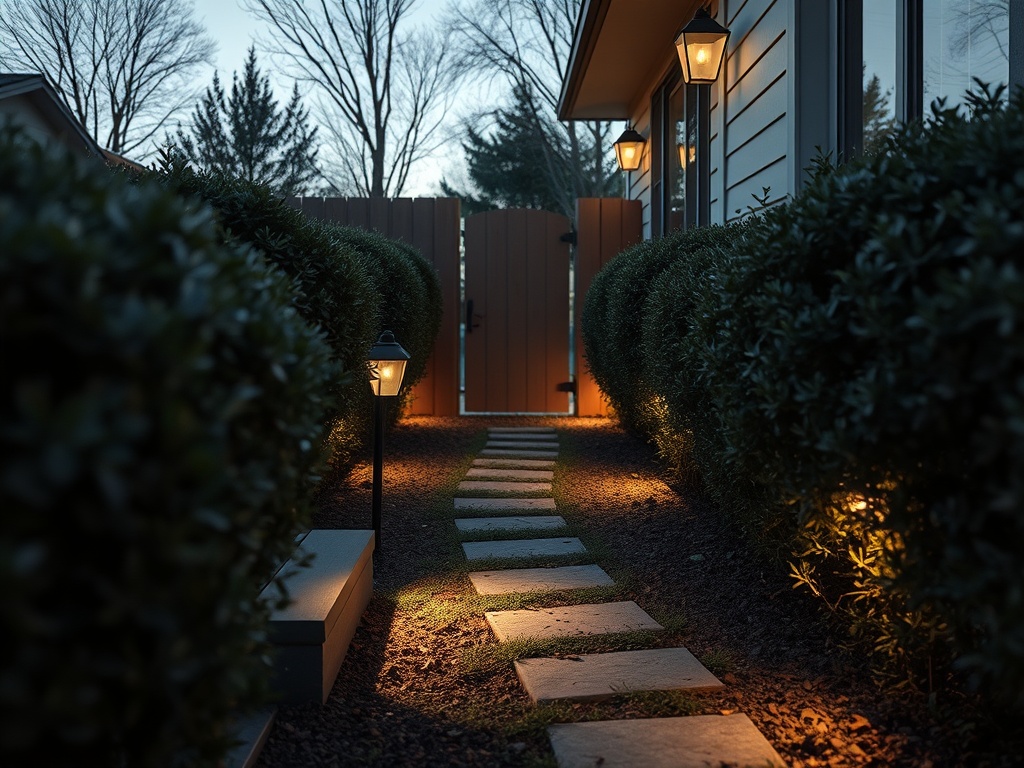
Begin at the main exterior door and trace the routes people use most often. Light abrupt level changes, steps, landings, narrow side yards, gates, and turns before adding decorative effects. A path does not need to be uniformly bright from edge to edge. Instead, create a readable sequence of illuminated points so the direction of travel remains obvious.
Shielded fixtures are usually more comfortable than bare lamps because the source itself is less visible. Positioning a light so it shines across a step or textured surface can also reveal shape better than pointing a bright beam directly toward the viewer. At gates and doors, favor light that makes the latch, threshold, and nearby walking surface visible without producing hard glare at eye level.
If the yard connects to a cooking or dining area, coordinate the circulation plan with how to plan an outdoor kitchen zone. That keeps pathway lights, prep lights, utility routes, and furniture locations from competing for the same space.
Choose the Right Lighting Effect for Each Area
| Yard area | Useful lighting approach | Main design caution |
|---|---|---|
| Walkways | Low, shielded path lights or soft downlighting | Avoid a runway effect from perfectly even spacing |
| Steps and level changes | Downlight or concealed step light | Keep the source out of direct sight when possible |
| Entries and gates | Focused task light near hardware and threshold | Prevent glare toward arriving guests or neighbors |
| Trees and planting beds | Selective uplight, downlight, or grazing | Do not illuminate every plant equally |
| Patios and seating | Warm ambient light plus task light where needed | Avoid a single bright fixture over the entire space |
| House facade | Gentle grazing or washing on selected surfaces | Limit spill into windows and adjacent properties |
These are design approaches, not performance guarantees. The best beam angle and fixture position depend on architecture, plant size, surface reflectance, viewing direction, and neighboring properties.
Use Contrast Instead of Maximum Brightness
A yard often looks more polished when there is a deliberate relationship between light and shadow. If every surface is equally bright, trees lose depth, walls appear flat, and the eye has no natural place to rest. Select a few important elements and let surrounding areas remain darker while still keeping travel routes legible.
Plan Fixture Positions Before Final Installation
Temporary testing is one of the easiest ways to improve a lighting layout. Mark proposed fixture positions, then view the yard from several points: the street, front door, main rooms facing the yard, patio seating, and the route back toward the house. A fixture that looks perfect from one direction may create glare from another.
For planting beds, account for growth. A small shrub can expand into the beam path, while a young tree may eventually need a different aiming angle. Keep fixtures accessible enough to clean lenses, adjust aim, and remove leaves or mulch that accumulate around them. When ground work is involved, durable gloves suited to digging and handling fixtures can help; this guide to the best garden gloves for different tasks explains why glove choice should follow the hazard and job rather than a one-pair-for-everything approach.
Use Controls to Limit Unnecessary Lighting
Timers, scheduling, motion sensing, and zoning can reduce unnecessary operating time and let different areas behave differently. Test controls and fixture aim together so a sensor does not repeatedly trigger a glaring or poorly directed light.
Keep Power and Weather Exposure in the Safety Plan
Outdoor electrical work is not only a design decision. Equipment must be appropriate for the environment, connections must be protected as required, and installation must comply with the rules that apply where the property is located. Low-voltage systems can simplify some residential projects, but they still require correct transformers, cable routing, connections, and fixture ratings.
Do not assume a fixture is suitable for every wet or damp condition because it is marketed as "outdoor." Check manufacturer instructions and applicable local requirements. If new circuits, hardwired line-voltage fixtures, buried electrical work, or uncertain existing wiring are involved, a qualified electrical professional can help determine the proper installation method.
Maintain the Lighting Plan as the Yard Changes
A good system needs occasional adjustment. Clean dirt and mineral residue from lenses, remove vegetation blocking beams, straighten fixtures shifted by soil movement or yard work, and review timer settings as daylight patterns change. After pruning or planting, walk the yard again at night to see whether the visual hierarchy still works.
If lighting work is being coordinated with seasonal lawn tasks, best fertilizer schedules for a greener lawn explains why turf care should follow grass type, active growth, soil needs, and regional guidance instead of a fixed calendar date.
Common Lighting Mistakes That Make Yards Harder to Use
- Too much brightness: More output can increase glare and flatten the scene rather than improve visibility.
- Unshielded sources at eye level: The lamp becomes the thing people see instead of the walking surface or feature it was meant to reveal.
- Evenly lighting everything: A uniform wash removes depth and wastes energy.
- Forgetting plant growth: Leaves and branches can block, scatter, or redirect light over time.
- Skipping controls: Lights that remain on when no one needs them add operating time without improving the yard.
A Simple Way to Review the Finished Yard
At each main entry point, check whether the route, level changes, and obstacles are easy to read and whether any fixture shines into your eyes or a neighboring property. Repeat the check from seating areas and indoor windows.
Landscape lighting recommendations involve both objective safety considerations and subjective design choices. This article is for informational and educational purposes only and is not a substitute for professional electrical, structural, code, or landscape-design advice.
For your next step, sketch the routes and activity zones on a simple yard plan, mark only the places that truly need light, and test those positions after dark before committing to the final layout.